

What sync and async requests are
A synchronous request holds the connection open until the result arrives, typically seconds. A single request gives you a single response, and there is nothing else to track. An asynchronous request returns an ID at once and the work continues in the background. You retrieve the result later by polling or by having Bright Data push it to a webhook or storage. Nothing waits on an open connection, so you can submit thousands of jobs in a minute and process them when they are ready.How each API implements the two modes
When to use each mode
Use synchronous requests when:- You serve a live user who is waiting, such as a “check this product now” button or search results on screen.
- You need results in seconds for a single input. On the Scraper API, send one input per
/scraperequest. - You are prototyping and want the simplest possible integration.
- You run scheduled jobs: nightly competitor monitoring, weekly rank tracking.
- You scrape at volume, hundreds of requests per hour or more, or more URLs than fit one sync call.
- You run discovery on the Scraper API: searching by keyword, finding posts by company.
- You want results delivered to a webhook, S3, Snowflake or other storage.
- You are building a pipeline where freshness within minutes is fine and you want fewer retries.
How the Scraper API flows
Synchronous:snapshot_id and finishes the job asynchronously; the data is still collected, you retrieve it as you would an async job. Code that calls /scrape must branch on the status code. The branch and the polling loop are in How to handle a 202 response.
Asynchronous:
GET /datasets/v3/progress/{snapshot_id} and download with GET /datasets/v3/snapshot/{snapshot_id}; pass endpoint on the trigger so Bright Data POSTs the records to your URL; or set a storage destination so the file lands in your bucket. Delivery destinations are listed in How to deliver results.
How the Web Unlocker API and SERP API flow
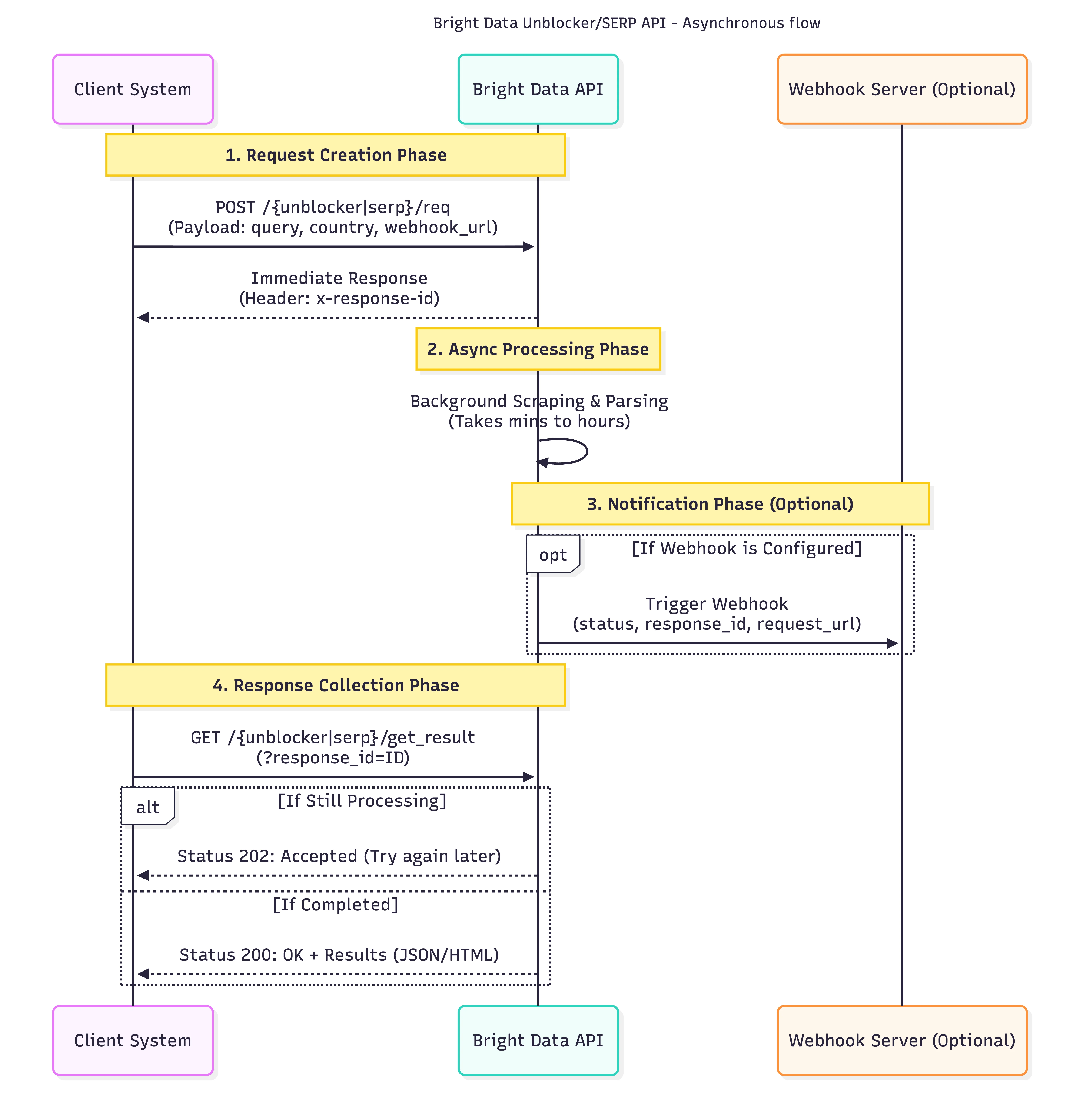
x-response-id header immediately. You are billed for the submission, not for retrieving the result, and the result is stored for 48 hours. Polling before the job completes returns a 202. Configure a webhook_url per request or in the zone settings and Bright Data POSTs a notification when the result is ready, from the IPs 100.27.150.189 and 18.214.10.85; allowlist them or your firewall may drop the call. A zone is either sync or async, so keep one zone of each if you need both.
What the tradeoffs are
Common misconceptions
Async is always faster than sync
For a few inputs, sync is faster: there is no queue step before the scrape begins. Use sync for small real-time lookups.Sync requests fail if they take too long
They do not fail. On the Scraper API a sync request that passes 1 minute answers HTTP 202 with asnapshot_id and the job continues; on the Web Unlocker API and SERP API a sync request holds the connection until the result arrives.
Common questions
Can I mix sync and async in the same application?
Yes. Most applications use sync for user-facing lookups and async for batch jobs. On the Web Unlocker API and SERP API that means one sync zone and one async zone.Is there a cost difference between sync and async?
No. Pricing is per successful record on the Scraper API and per request on the Web Unlocker API and SERP API, whichever mode you use. Retrieving an async result is free.What happens if my webhook is down when the results are ready?
The Scraper API retries webhook delivery when your endpoint returns a non-200 status or times out. For guaranteed delivery, use a storage destination instead.What if I lose a response ID or snapshot ID?
A Web Unlocker API or SERP API response ID cannot be recovered, so store it with the request metadata when you submit. Scraper API snapshot IDs are listed by Get snapshots for 30 days.Next steps
Scrape in bulk with async requests
Trigger, monitor and download a Scraper API batch job.
Deliver results
Webhook, S3, Google Cloud, Azure, SFTP and Snowflake.
SERP API async requests
Async zones, polling and webhook IPs for search results.
Web Unlocker API async request
The async form of the unlocker request.